A Navy acquisition leader warned congressional members on Thursday that China is meeting the United States on nearly every maritime mark, raising the importance that shipbuilding continue on an upward trajectory.
William F. Mahan, performing the duties of assistant secretary of the Navy (ASN) for research, development and acquisition, made the remarks Thursday to an audience of lawmakers and industry partners on Capitol Hill as part of the U.S. Navy League’s Congressional Shipbuilding Caucus breakfast. His main message was a simple one: modernization and restoration is integral to the U.S. maintaining its maritime industrial base.
But that is just part of what concerns him. The other point of emphasis was the People’s Republic of China, which he said is “executing the Mahanian playbook flawlessly”—referencing the famous work of historical naval strategist Alfred Thayer Mahan, The Influence of Sea Power upon History.
“We now face a national challenger that is competing with the United States across every domain, but there is only one domain that will determine whether they succeed in their national ambitions—the maritime domain,” Mahan said, adding that true sea power requires a lethal combatant fleet combined with a robust commercial shipping and shipbuilding industrial sector.
That translates to a larger emphasis on the United States’ shipbuilding industry, which has faced criticism by President Donald Trump himself.
In late April, then-Navy Secretary John Phelan left his position when reports suggested he and the president were at odds—including on the issue of shipbuilding, which concerned Trump simultaneously as the U.S. was concluding the second month of its war with Iran and faced bottlenecks in the Strait of Hormuz.
In April 2025, the U.S. Government Accountability Office issued a report stating that Navy shipbuilding is “consistently over budget and behind schedule,” partially laying blame on private companies “for decades” not meeting the service’s goals to increase fleet size. That has led to shipbuilding delays that lasted as long as three years in some instances.
“America is, and always will be, a maritime nation,” Mahan said. “Our prosperity, our security, and our way of life are entirely dependent on the free flow of commerce across the world’s oceans.
“Against the threats we face, the American shipbuilding industry must answer the call, or risk everything we have built over the last two and a half centuries.”
Shipbuilding Budgeting in NDAA
Mahan’s speech on Thursday played on the backdrop of important defense budget deliberations continuing on Capitol Hill, in the form of both the U.S. House and Senate finalizing their respective versions of the Fiscal Year 2027 National Defense Authorization Act (NDAA).
He praised shipbuilding funding provided through the $45 million budget in the FY26 NDAA and One Big Beautiful Bill Act, including critical “down payments.” The current FY27 NDAA framework would, if passes as is, up the ante and provide military investments exceeding that Mahan said will leverage generational investments across auxiliary supply lines while stabilizing the industrial base.
“The president and Congress have done their part,” Mahan said. “Now it’s up to the Navy and industry to do ours. And we will start with our most critical asset. Not our dry docks. Not our cranes. Our people.”

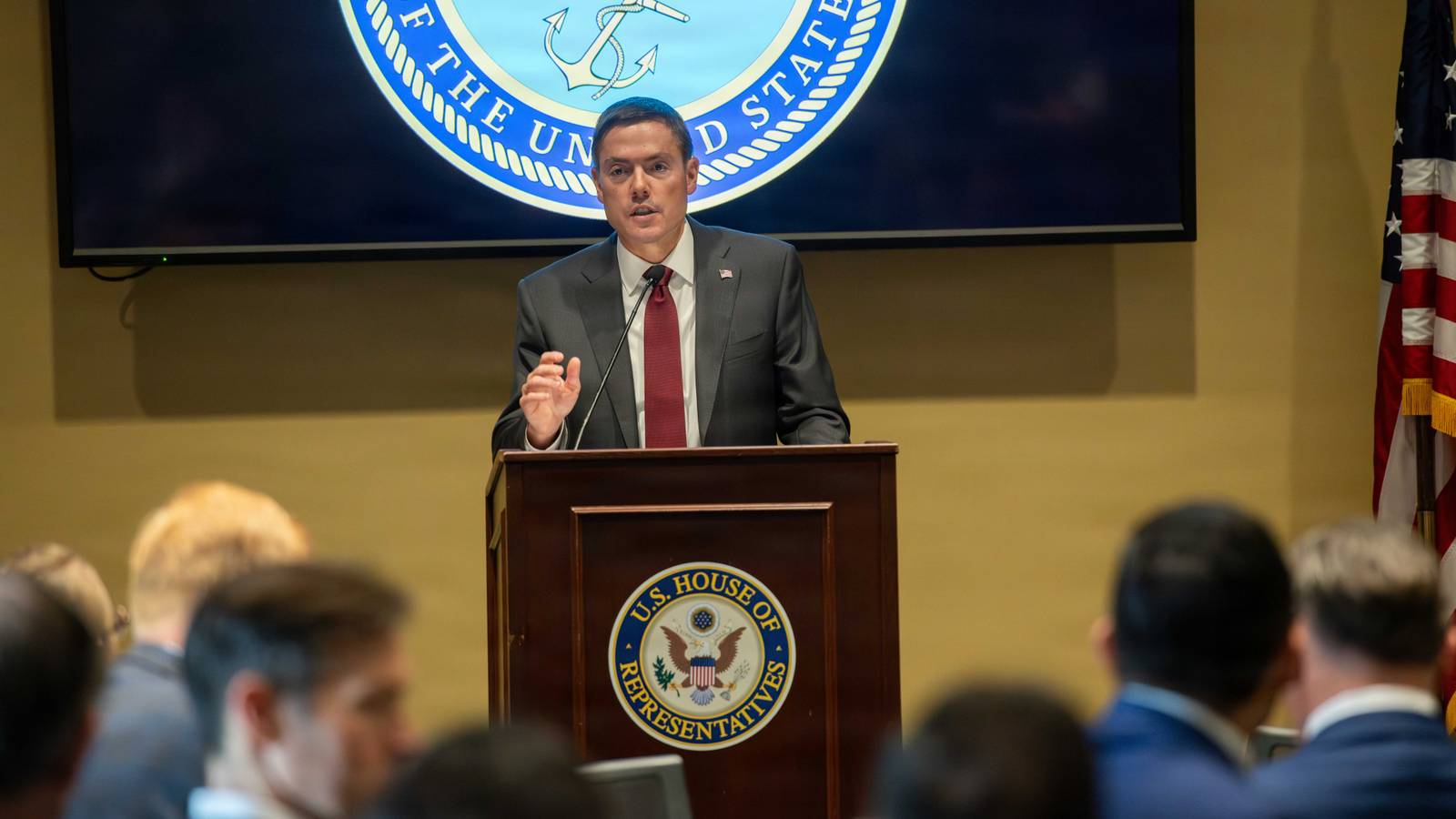
WASHINGTON (June 25, 2026) – William F. Mahan, Performing the Duties of Assistant Secretary of the Navy for Research, Development, and Acquisition, addresses congressional and maritime industry leaders during the Congressional Shipbuilding Caucus breakfast on Capitol Hill. During his remarks, Mahan emphasized the urgent strategic necessity of stabilizing the defense industrial base and called on lawmakers to fully pass the administration’s pending $65.8 billion National Defense Auth
Shipbuilding’s most important assets are the nation’s welders, pipe fitters and electricians, he added, stressing how highly competitive wages and superior benefits must be offered to recruit and retain men and women to such a “noble” profession.
Having those individuals coupled with 21st century manufacturing tech, robotics and advanced data analytics is the recipe for success, Mahan said, believing that if everything comes together as intended, “We can accomplish things we never thought were possible.”
All of that is in addition to integrated automated best practices from international allies, which in turn will reduce construction timelines.
“ChatGPT cannot build an aircraft carrier. Gemini won’t build our destroyers…or our battleship,” Mahan said. “It takes American muscle, American grit, and American engineering prowess. We need to invest in that workforce and that capability like our national survival depends upon it—because it does.”