
When retired Marine Maj. James Capers Jr. entered the Pentagon’s Hall of Heroes for his Medal of Honor ceremony, he stepped into a room reserved for the nation’s most extraordinary acts of battlefield valor.
For much of America, the ceremony was an introduction to one of the Vietnam War’s greatest stories.
For many Marines, particularly those in the reconnaissance community, it was something different.
It was the nation finally recognizing a leader they had considered legendary for decades.
Military decorations often define moments. Within the military, however, reputations are built over entire careers, through the stories that are told in ready rooms, classrooms and field exercises long after the fighting ends. By the time Capers received the Medal of Honor, nearly six decades after the battle at Phu Loc, his reputation had already become part of Marine Corps lore.
The medal didn’t create that legacy. It confirmed it.
The Patrol That Changed Everything
On March 31, 1967, then-2nd Lt. James Capers led a nine-man Force Reconnaissance patrol deep into enemy-controlled territory near Phu Loc, South Vietnam.
The mission was straightforward: gather intelligence on enemy troop movements. Instead, the team found itself surrounded by a much larger North Vietnamese force.
For four days, the Marines fought while attempting to evade encirclement.
Capers was shot twice. He suffered multiple shrapnel wounds and a broken leg. Despite his injuries, he continued directing the defense, coordinating supporting fires and encouraging his Marines as they fought toward extraction.
When a rescue helicopter finally reached the team, the aircraft struggled under the weight of the wounded Marines. According to accounts of the battle, Capers twice tried to leave the helicopter so the others could survive the flight out. His fellow Marines refused to let him go.
Even then, the team would not leave behind King, the military working dog that had accompanied them throughout the mission. Years later, Capers said King shielded him from part of the blast of a claymore mine, likely saving his life.
The actions earned Capers the Medal of Honor nearly 60 years later. But Marines had been telling that story long before the citation changed.
A Reputation Built Long Before the Medal
Every service has figures whose influence extends well beyond the awards on their uniforms. Within Marine reconnaissance, Capers is one of those figures.
His name appears in conversations about leadership, perseverance and what it means to place the mission and the team ahead of yourself. Younger Marines who never served with him still know his story, not because they memorized a citation, but because senior Marines passed it along.
That is how military legends are often created. Not through ceremonies. Through trust.
Capers’ career reflected that same pattern.
He became one of the Marine Corps’ pioneering reconnaissance officers during the Vietnam War and later became the first Black Marine to command a reconnaissance company. He continued serving after recovering from wounds that could easily have ended his military career, mentoring Marines and building the reconnaissance community that followed.
Those accomplishments matter.
But ask many Marines why they admire James Capers, and they are more likely to describe the kind of leader he was than the medals he received.

The Team Always Came First
Perhaps the clearest window into Capers’ character came after the Medal of Honor was finally presented. Rather than focus on his own actions, he immediately shifted attention to those who fought beside him.
Receiving the Medal of Honor for what we did at Phu Loc is a profound and humbling milestone, but this medal does not belong to me, Capers said. It belongs to the exceptional men who fought with me, whose absolute trust, preparation and shared sacrifice made survival possible in the darkest of circumstances.
The statement echoes a theme common among many of the nation’s highest-decorated service members.
The Medal of Honor may bear one name. The recipients rarely believe it belongs to only one person.
For Capers, that extended beyond the Marines on his patrol.
He also remembered King, the military working dog whose actions he credited with helping save his life.
That instinct, to redirect praise toward others, helps explain why Marines speak about Capers the way they do.
Leadership in combat is measured not simply by courage, but by responsibility.
Capers’ story has endured because it reflects both.
Why the Medal Still Matters
If Marines already regarded James Capers as a legend, why does the Medal of Honor matter? Because military history matters.
Future generations of Marines will study the battles, decisions and leaders that shaped the Corps. Awards become part of that permanent record, helping define what extraordinary leadership under fire looks like.
The Medal of Honor did not rewrite what happened at Phu Loc. Nor did it change how Marines viewed James Capers. It did something equally important.
It ensured that one of the Marine Corps’ defining stories of leadership will now stand alongside the nation’s most recognized examples of valor.
For younger Marines, that matters. Not because recognition changes the man. But because it preserves the example.
 A Legacy That Continues
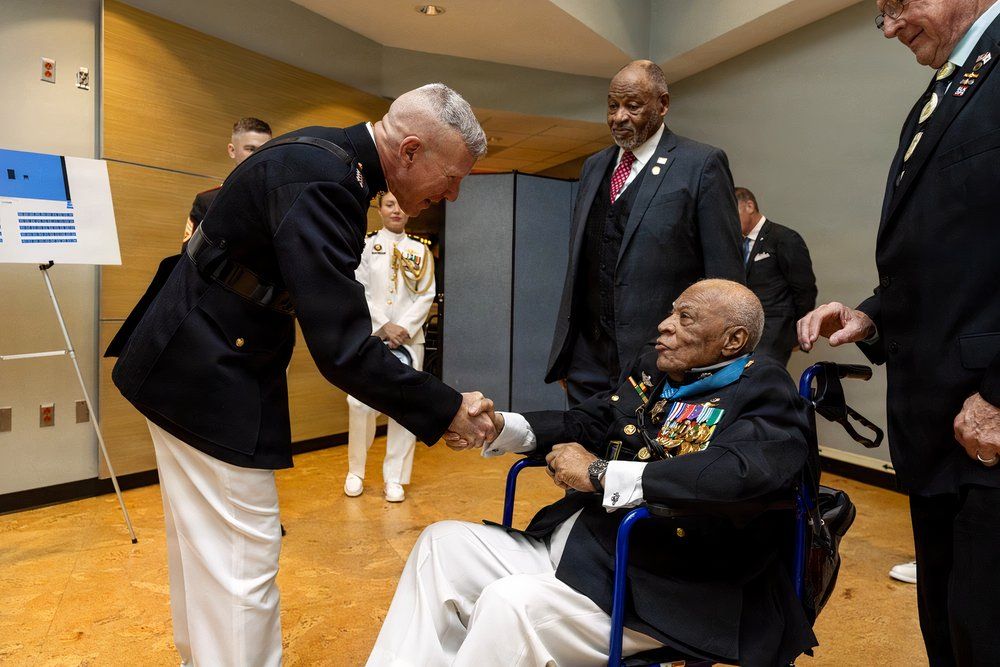
The Hall of Heroes ceremony also recognized Marine Col. John Ripley, whose Medal of Honor was awarded for his actions during the Battle of Dong Ha Bridge in 1972.
Although the two Marines fought in different battles five years apart, their stories share striking similarities.
Neither man spent much time talking about himself. Both consistently directed attention toward the Marines who fought beside them.
Both viewed leadership as something earned through responsibility rather than recognition. Standing at the podium during the ceremony, Capers reflected on the country he had served.
This is the greatest country in the world,” he said. “I fought for that flag. I believe in it.
It was a simple statement from a man whose military career was anything but ordinary.
Nearly 60 years after leading a wounded reconnaissance team through one of the Vietnam War’s most desperate battles, James Capers’ Medal of Honor serves as a reminder that recognition can arrive long after the fighting ends.
For the Marines who had carried his story forward for generations, however, the ceremony was never about creating a legend.
It was about ensuring that future Marines, and the nation they serve, would understand why one already existed.