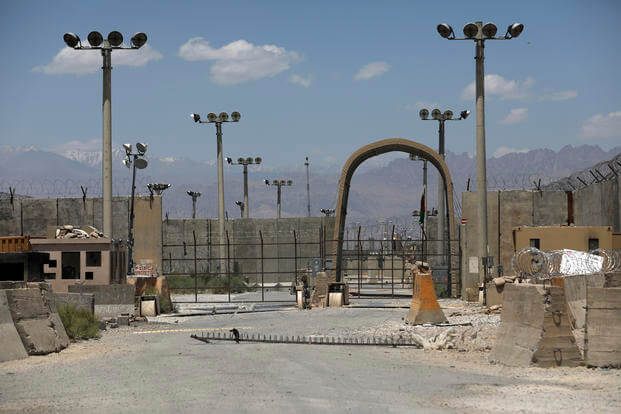
The Supreme Court ruled Wednesday that U.S. troops may sue military contractors for their injuries, siding with a soldier who was badly injured when a Taliban operative working at the Bagram Airfield detonated a suicide bomb.
Five soldiers were killed and 17 were wounded, including 20-year-old Winston Henceley, who suffered a fractured skull and brain injuries and is permanently disabled.
In a 6-3 decision, the court ruled that neither federal law nor the Constitution shields military contractors if their mistakes or negligence result in solders being injured in a combat zone.
Justice Clarence Thomas wrote the court’s opinion for an unusual majority that included Justices Sonia Sotomayor, Elena Kagan, Neil M. Gorsuch, Amy Coney Barrett and Ketanji Brown Jackson.
In the past, Thomas has objected to court precedents that prevented troops from suing the U.S. government for their injuries, including from medical practice.
And he said that rule should not be expanded to shield military contractors.
Justice Samuel A. Alito Jr. dissented, along with Chief Justice John G. Roberts and Justice Brett M. Kavanaugh.
“Because the Constitution gives the federal government exclusive authority over foreign affairs and the conduct of wars, federal law preempts all state law that substantially interferes with the Government’s exercise of those powers,” Alito wrote.
Hencely had tried to stop and question Ahmad Nayeb, an Afghan employee, as he walked toward soldiers who had gathered for a Veteran’s Day 5K race in 2016.
The Army concluded that Hencely’s intervention “likely prevented a far greater tragedy,” and its investigation concluded that the Fluor Corporation that had a contract to run operations at the base was primarily responsible for the attack.
The report said Fluor was negligent in hiring an Afghan who had been a Taliban operative, and it failed to closely supervise him.
But Henceley sued Fluor for his injuries; a federal judge in South Carolina and the 4th Circuit threw out his suit.
“During wartime, where a private service contractor is integrated into combatant activities over which the military retains command authority, a tort claim arising out of the contractor’s engagement in such activities shall be preempted,” the 4th Circuit said.
The court agreed to hear his appeal and overturn the 4th Circuit, clearing his suit to proceed.
This story originally appeared in Los Angeles Times.
©2026 Los Angeles Times. Visit latimes.com. Distributed by Tribune Content Agency, LLC.
Read more: Health Experts Weigh In on Effects of DOD’s Optional Flu Vaccine Policy
© Copyright 2026 Los Angeles Times. All rights reserved. This material may not be published, broadcast, rewritten or redistributed.